
Table of Contents
Q2 2026 Release Notes
April - June 2026
New Features
Camera Bulk Edit & Delete: Select multiple cameras using checkboxes (including select all), then bulk edit settings (active mode, credentials, recording mode, schedule, notifications, and cloud) or delete them in one operation. A confirmation dialogue lists all affected cameras before any destructive action
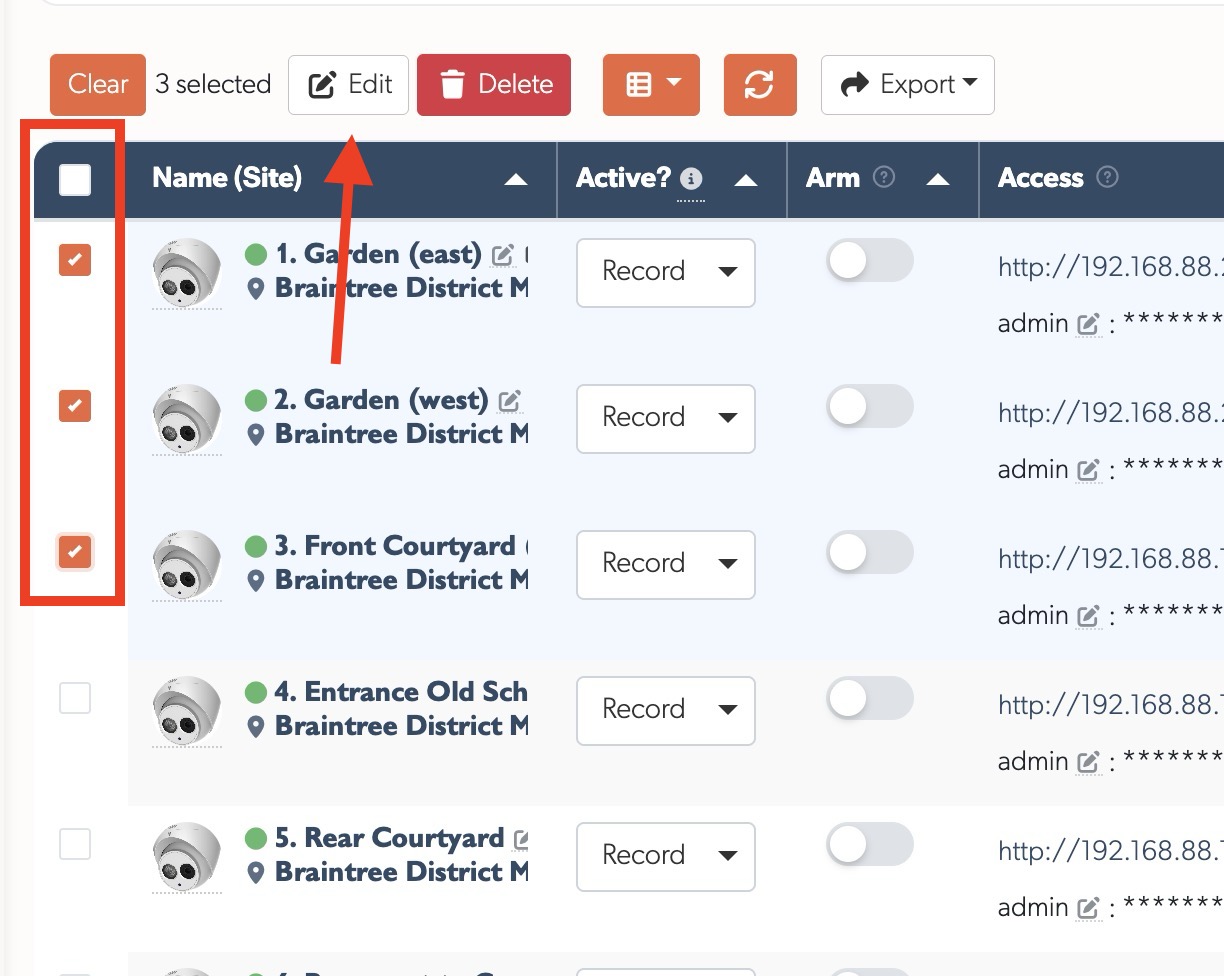
ANPR Plate Bulk Edit & Delete: The ANPR Plates list on a camera now has the same multi-select as the cameras list. Tick several plates (or select all), then change their group (whitelist or blacklist) and expiry date together, or delete them in one step with a confirmation that lists every plate affected
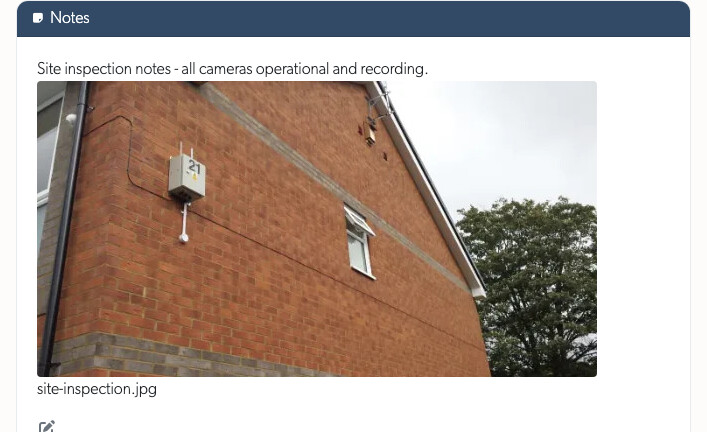
File Attachments in Notes: Notes editors now support file uploads via drag & drop, paste, or the attach button for images, documents (PDF, Word, Excel, PowerPoint, CSV), and videos (up to 100MB). Attachments display as thumbnails and can be clicked to view full-size. A new management page under Settings shows all uploaded attachments, which resource they belong to, and lets you filter by status (active or orphaned) and file type to find and delete unused files
One-Click Camera Activation: Network devices flagged as requiring activation now show an Activate button next to their IP on the Devices page. A single click sets a secure password and sensible defaults on the camera or recorder, ready to use straight away
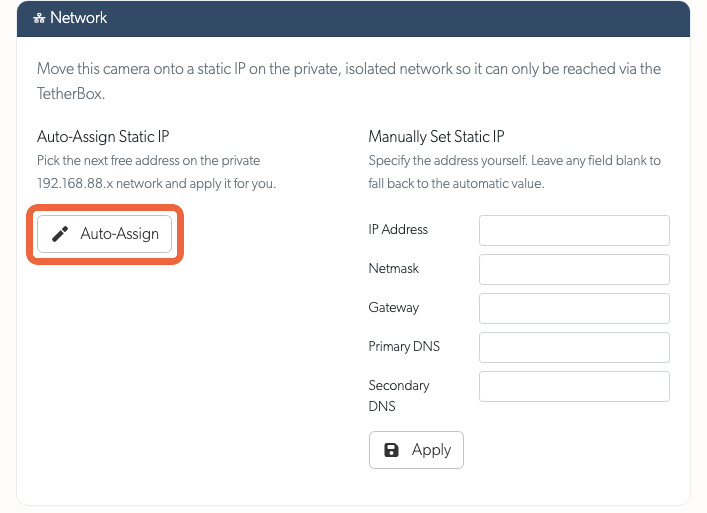
Network Tab: Static IP Assignment: Cameras with a working native API and a TetherBox running 6.14 or newer get a Network section on the API tab. Auto-Assign picks the next free address on the private 192.168.88.x network in one click, or fill any of the IP, netmask, gateway and DNS fields manually. Once applied a confirmation dialogue explains it can take up to two minutes for the camera to reboot and reconnect. The Auto-Assign button greys out (with a tooltip explanation) for cameras already on a private static network
Monitoring Station Operator Console: A focused full-screen console for monitoring-station operators. Each event opens with a toolbar to set it pending, release it back to the queue, mark that action was taken, close and jump straight to the next event, or call a supervisor. A new Operator user type sees only the events for the zones it is assigned, with event-list defaults tuned for sit-and-watch use. Any operator can be marked a Supervisor to receive escalation calls. A new help guide walks through the whole workflow
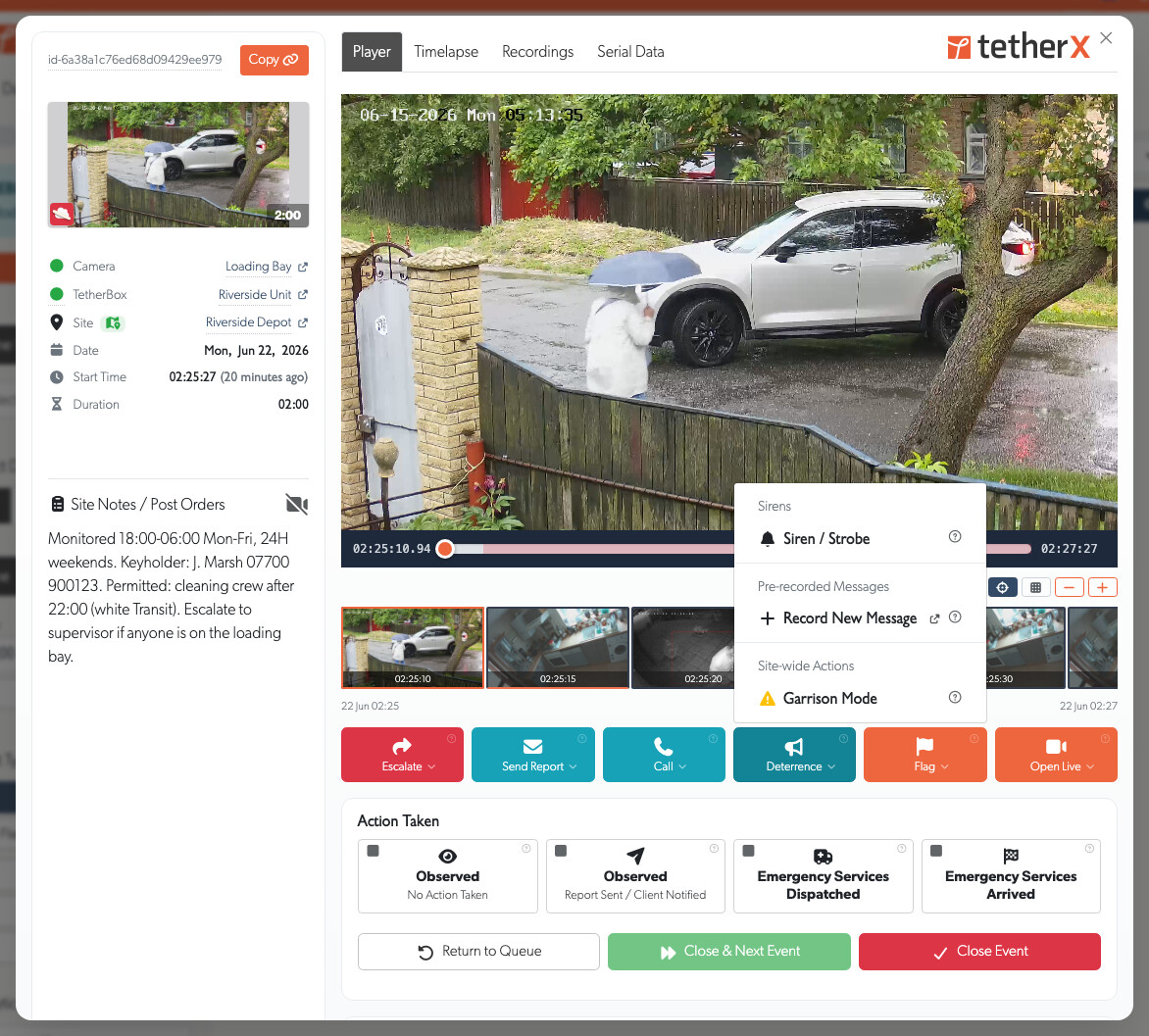
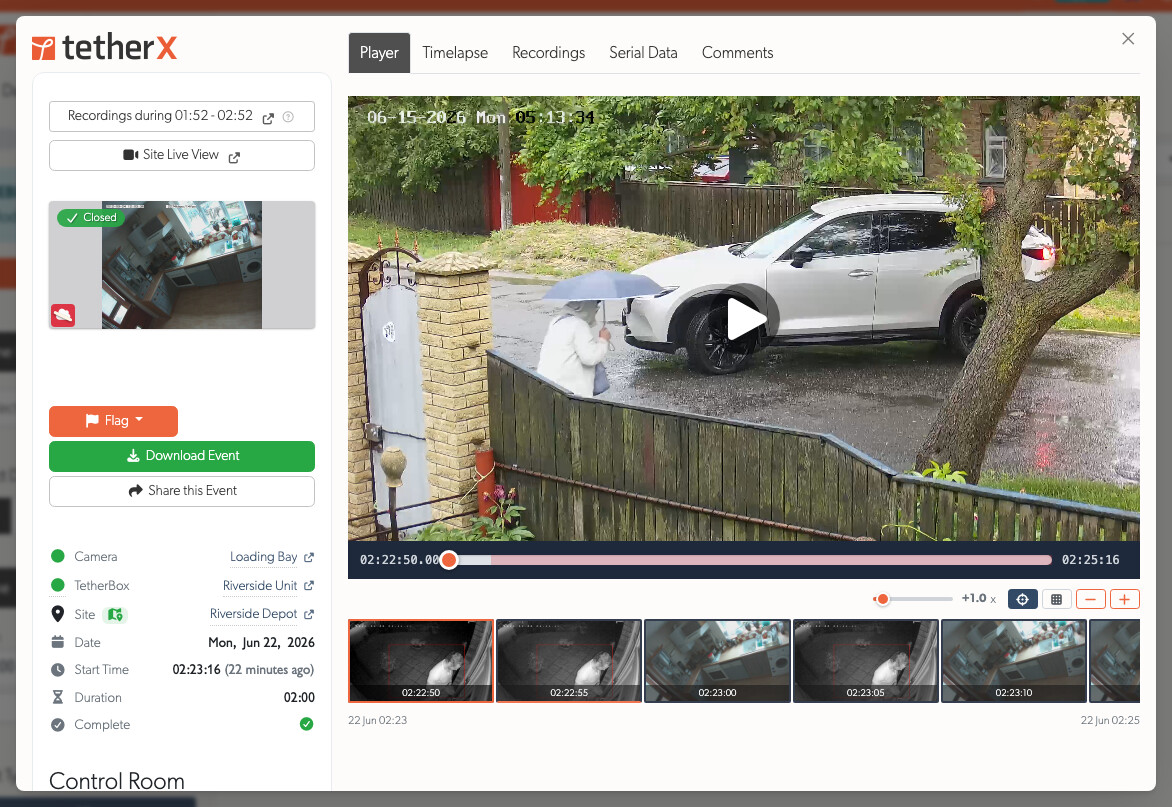
Redesigned Event View: Opening an event now brings it up in a focused pop-up over the events list, so you keep your place while reviewing an incident and close it to go straight back. Regular users and monitoring-station operators now share the same clean layout, with the metadata in a tidy column beside the player. Each event thumbnail carries a status pill (pending, closed or hidden) with a tooltip showing who actioned it, when, and how long it took from the event starting to being dealt with. A new Control Room panel on the event explains what a monitoring station has done, observed, report sent, or emergency services dispatched and arrived, and lets you help by reviewing and closing false events yourself
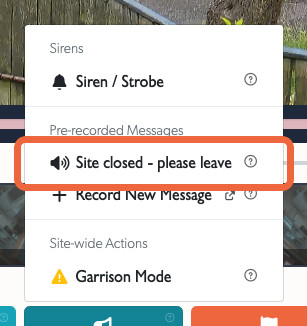
Audio Challenge (Talk Down): Speak to people on-site straight from a camera's live view or the monitoring-station console. Hold a button to talk, play a pre-recorded warning, or hold a full two-way conversation on cameras with built-in echo cancellation. Each camera chooses where its audio plays: the TetherBox 3.5mm jack, a network (IP) speaker, or the camera's own speaker. IP speakers are registered once from the Devices page and then appear as a speaker output on any camera on that TetherBox. Cameras with talkdown available are marked with a TALK badge in the camera picker, and a new help guide lists the supported camera and speaker brands
Improvements
- Richer Event Classification (work in progress): Events are being reorganised around fifteen meaningful categories (motion, objects, movement, clothing, behaviours, vehicle, anpr, tampering, environmental, etc.) so you can filter for exactly what you care about. Cleaner notifications (no more stutters like "Motion Detected detected"), a help page that updates automatically whenever a new event type is added, and room for new detections like PPE checks, vehicle violations and demographics
- Exclude Motion Filter: The Events filter sidebar has a new Exclude motion toggle. Switching it on hides plain motion events, both TetherBox motion detection and basic camera motion, along with continuous recordings, leaving only the meaningful detections such as people, vehicles, intrusion, tampering and others. A quick way to cut through the noise on busy sites
- Faster Events Filtering: Picking a date in the Events filter sidebar now applies straight away instead of waiting for the Apply button, with a one-click clear icon inside the field. Box-select can start anywhere in the grid, including the weather and date header row, and the list scrolls automatically as you drag towards the bottom
- Flag Events for a Set Period: Flagging an event now offers a retention period (for example 7, 30 or 90 days) instead of a plain on/off toggle. The flag clears itself automatically once the period passes, so an important event stays highlighted for exactly as long as it is needed and no longer
- Resize Event Thumbnails: The event player timeline strip, and the Timelapse and Recordings tabs, now have plus and minus buttons to make thumbnails larger or smaller, with a grid view that fills the available width cleanly instead of leaving a ragged edge. The chosen size is remembered per view and animates smoothly, the buttons grey out at the smallest and largest sizes, and on a phone the grid always keeps at least two columns so thumbnails never run off the screen. The currently playing frame in the timeline strip is clearly highlighted, and the strip now only scrolls sideways within itself so the page no longer jumps when following playback
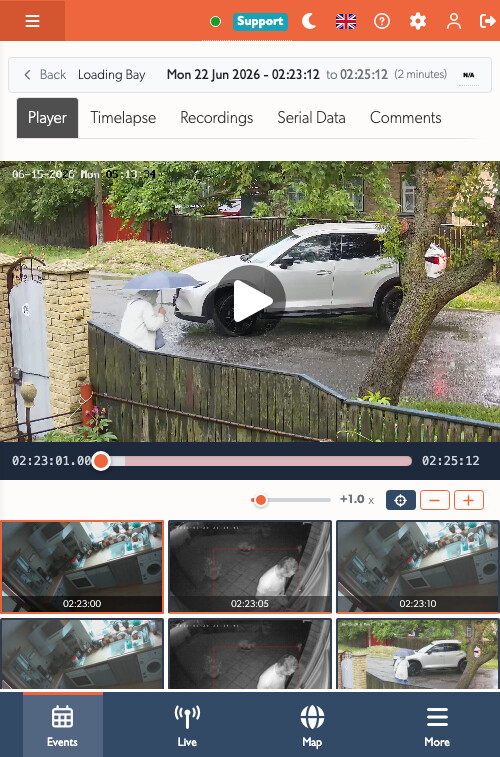
Full-Screen Event View on Phones: Opening an event on a phone now fills the screen. The video and timeline grid stretch edge to edge, the page itself no longer scrolls, and only the thumbnail grid scrolls so the bottom menu never covers the last row. The scrub bar sits directly under the video as part of the player, with a larger, more finger-friendly handle, and the tabs along the top scroll sideways when there are more than fit on one line
Redesigned Tables: All data tables rebuilt with resizable, reorderable, and hideable columns, preferences remembered per table, a search bar, column visibility toggle, and CSV/Excel export. Formatted columns (CPU usage, storage size, time durations) now sort by their underlying values, the Name column is always second and bold, clicking a row opens the detail modal, and related links (company, user, timeline) open in modals instead of navigating away. The Exports page uses the same format; while a table loads the dimming overlay stays light and the headers clickable so you can re-sort without waiting; and camera name columns show a model image (or a colourful letter avatar), also on the TetherBox and Health Cameras tabs
Clearer Session History: The audit log now reads in plain language, with each action naming the site, camera, zone, user or event it relates to. Cameras show a health dot and live hover preview, users a type icon, and recordings and events a thumbnail. Filters and parameters resolve IDs to names with links, camera passwords stay hidden behind an eye toggle, Windows 11 is now told apart from Windows 10, and noise like repeated page views, tab switches and preset look-ups no longer clutters the list. The timestamp is now a button that opens the session
Device Service Filtering: Filter devices by detected service (Web, SSH, Video, VNC, Other) or by specific open ports. Service badges appear next to device names showing available interfaces at a glance
Private/Randomised MAC Warning on Devices: The Devices page now shows an information note, with an inline help tooltip, explaining that smartphones and laptops with randomised MAC addresses do not appear in the list, with steps for turning the feature off on iOS and Android so a specific device can be monitored
Cameras Behind Wireless Bridges Keep Recording: Cameras reached through a wireless link that hides their individual MAC address (such as a Ubiquiti airMAX bridge) no longer lose their saved credentials and IP when the TetherBox cannot pair them to a network device. The Device Detection help page gains a section explaining how to enable WDS transparent bridging to restore per-camera tracking
Redesigned Health Summary: The Health page summary tab has a clearer at-a-glance design with a fleet health score ring, a plain-language status headline, and metric cards that jump straight to the matching list when clicked. The timeline filter now stays applied after a page refresh, and the figures count only activated TetherBoxes so units not yet assigned to a site no longer skew the totals
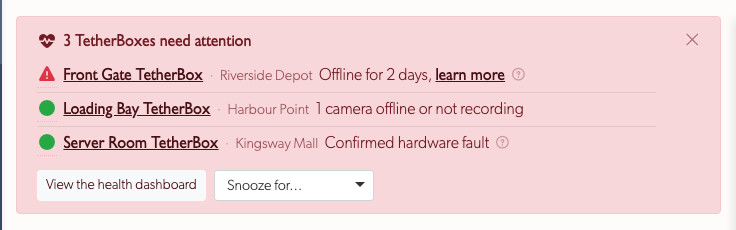
Health Alert Banner: Integrators and staff now see a banner across the top of the events page whenever a TetherBox needs attention. It lists only critical problems, units offline, cameras that have stopped recording, hardware faults and the like, with a link straight to each affected unit. Footage gaps and other non-critical warnings stay off the banner and remain on the unit's Health page. The banner can be snoozed, and an offline unit you already know about can be cleared from it by setting that unit inactive on its settings page
Storage-Slow Event Indicator: Events recorded while a TetherBox's storage was running slow now carry a dedicated icon on the timeline, so transient storage stalls are visible at a glance instead of silently shortening or emptying the event
Disk Write Error Detection: TetherBoxes now report disk write errors (EIO) coming back from the kernel. A new I/O Errors badge appears on the unit page and a dedicated panel lists the affected drives, so a disk that is failing writes is visible before it silently starts dropping recordings
Faster Events, Cameras and Recordings Pages: Removed hidden per-row database lookups that accumulated on long lists, so page loads stay snappy as accounts grow
Redesigned Page Loading: Cleaner page load indicator with a subtle indeterminate progress bar and branded loading overlay. Fonts load with higher priority to reduce text reflow during navigation
Notes Improvements: Links and attachment images in note previews (map callouts, event popovers) now open in a new tab or full-size preview instead of navigating away. Images are constrained to fit the container, and callouts no longer wait for images to load before appearing
Unsaved Changes Warning on User Profile: Editing a user, then closing the profile modal or navigating away with pending changes, now shows a confirmation dialogue so an accidental click no longer loses the edit. The same warning also appears after a failed save (validation error) until the change is saved or discarded
Smarter Company Pre-Selection for New Integrators: Adding an integrator only fills in the company automatically when you are yourself an integrator with a single company, so the new account inherits it. Staff, admins, and integrators who work for several companies now start with no company pre-selected and choose one deliberately, instead of an unrelated company being assigned by accident
DMS Coordinate Support: Site coordinates can now be entered in degrees-minutes-seconds format (e.g.
73°42'14.5"W) and are automatically converted to decimalComplete Spanish, French, Hebrew, Russian and Ukrainian Translations: Filled every missing interface string across the five non-English languages, so newer screens now read in the chosen language throughout instead of falling back to English
Updated Documentation: New articles for TetherX AI, the Camera API Tab and Static IP Configuration; refreshed Notifications, Health Report and Exporting Cameras; Connecting to DVRs and NVRs now covers splitting a DVR/NVR across multiple TetherBoxes; and the Hardware Specifications page is reorganised into a concise overview with new CPU Recommendations, Storage Hardware Recommendations and Raspberry Pi TetherBox companion pages. Calipsa and DeepAlert integration docs have moved out of the knowledgebase, both integrations remain fully supported (contact support)
API Changes
Everything developers need in one place. The full interactive reference lives under Developers.
New Endpoints
TetherBox Uptime Probe:
GET /api/v3p/tetherboxes/:serial/upis a passwordless public endpoint that reverse-proxies through the VPN to the TetherBox itself. Returns HTTP 200 when the box is reachable and its app is responding, or a 5xx error otherwise. Designed to be plugged straight into HTTP uptime monitors such as Uptime Kuma or Uptime Robot without needing an API token or any response parsingBulk ANPR Plate Changes: Two endpoints apply one change across many plates in a single call.
POST /api/v3p/anpr_plates/bulk_updatesets the same group or expiry date on every plate id you pass;POST /api/v3p/anpr_plates/bulk_destroyremoves them. Both return a per-plate result so you can see exactly which succeeded and which were rejected, plate ids belonging to cameras you cannot access are skipped rather than failing the batch, and both take a JSON body so they work reliably from any client
Newly Documented Endpoints
These public endpoints were already live but missing from the reference. They are now fully documented, each with its parameters and an example response:
GET /api/v3p/anpr_plates/:idandPUT /api/v3p/anpr_plates/:id- read and update a single ANPR plate, alongside the existing list, create and deleteGET /api/v3p/zones/:id/snapshot- single still JPEG snapshot from a zone's camera, fetched live over the VPN, with optional quality, width and height. Honours the camera's remote viewing permission and live scheduleGET /api/v3p/anpr/:id/plate_image- the cropped number plate image (JPEG) for an ANPR detection, the same URL exposed asimage_urlon each detection in the ANPR listGET /api/v3p/relay_devices- list standalone network relay boards (door strikes, gates, generic IO), as distinct from the camera-attached relays controlled through the zone endpointsPOST /api/v3p/relay_devicesandDELETE /api/v3p/relay_devices/:id- add and remove relay boardsPOST /api/v3p/relay_devices/:id/on,/offand/status- switch a relay output on or off and read its current stateGET /api/v3p/timelapse/:zone_id/:date/thumbnail- the daily timelapse thumbnail (JPEG) for a zone on a given date
Bug Fixes
- Event playback is more reliable: The event player no longer gets stuck on an endless loading spinner. It now buffers every remaining segment after you scrub, steps over the tiny gaps that can form between recordings, recovers from quick back-and-forth scrubbing near the end of a clip, and if playback genuinely stalls it shows a clear Reload prompt instead of hanging, including on iPhone and on slow or unstable connections. Recordings stored only in the cloud now download without "Access Denied" errors, filmstrip and timelapse thumbnails fall back to cloud storage (or the TetherBox) when the device copy is missing, and the "All" display mode shows pending, hidden and closed events correctly on first load.
- Phones and tablets: A sweep of fixes for the mobile event and live views. Full-screen event and camera views now start streaming straight away, the multi-camera grid lines up cleanly between the top and bottom menus, the menu button no longer disappears after viewing an event, and the event details panel and its actions stay reachable above the bottom menu. The scrub preview stays solid while dragging, swiping now scrolls the page (panning only starts once you have zoomed in), a recovered camera clears its "No Signal" message on its own, and the white strip beside the iPhone notch and the off-centre loading spinner are gone. The "..." thumbnail menu now opens anchored to its button and stays clickable across the events list, the player and the operator console.
- Health, devices, tables and the platform: The Health Report now flags only genuine problems, real over-temperature drives, packet loss confirmed by footage gaps, and inadequate or missing recording storage, and its summary no longer claims all is well while devices are offline (admins are also no longer auto-subscribed). Offline monitored devices are always visible now on both the Devices page and the TetherBox IP Devices tab, online and active filters default to showing everything, a TetherBox wrongly shown offline relearns its address automatically, notes carry over when you replace a unit, and deletions show a clear confirmation (with the reason when one is blocked). Tables are fixed for dark mode, server-side pagination counts, height after reloading, ANPR pagination and the column-selector dropdown clipping; the events-page health banner snooze now saves reliably, opening a modal no longer scrolls the page behind it, and a user with an uploaded profile picture in the Users list now shows their name beside the avatar instead of beneath it.
Statistics
| Metric | Value |
|---|---|
| Commits | TBD |
| Lines added | TBD |
| Lines removed | TBD |
| Net change | TBD |